
Share on Social Media


Current News Stories
Written By: Ian Silvester
As a child, Beau Sampley was fascinated with the stars. So much so, that it was a dream of his to become an astronomer. This summer, he had the opportunity to intern at a place capable of helping him, and others, reach the stars.
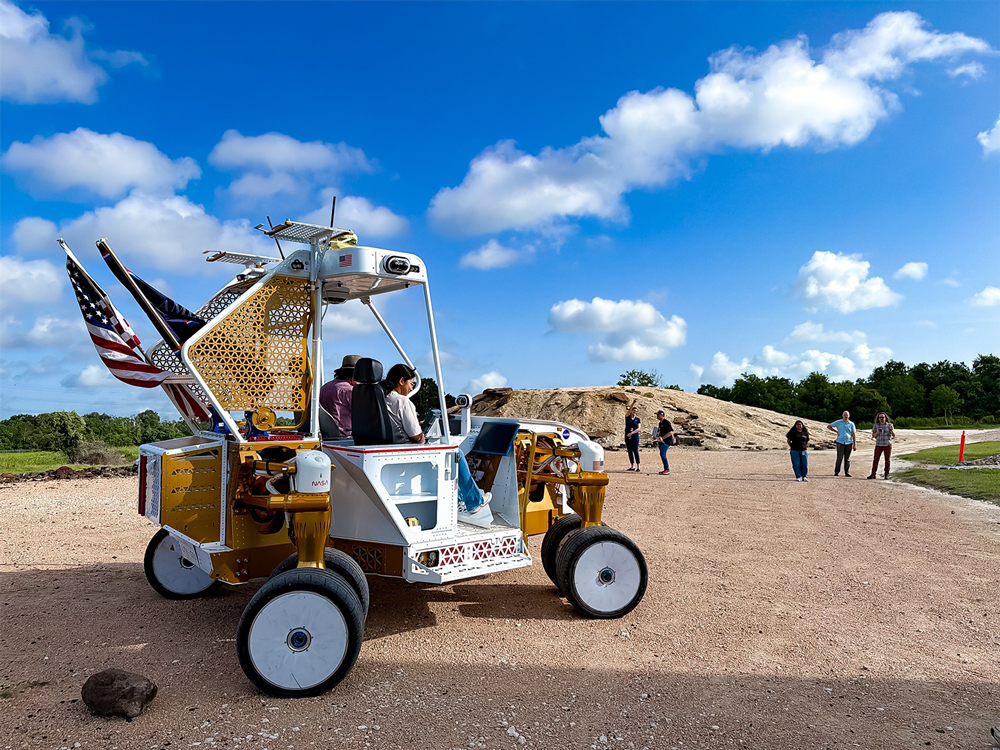
Beau joined fellow University of Arkansas – Fort Smith engineering student and Autonomous Vehicle Challenge (AVC) teammate, Hudson Reeves, at NASA’s Johnson Space Center (JSC) in Houston. While Beau didn’t spend the 10-week internship studying the cosmos, he was working on the next closest object in space: The Moon.
“My main project was what they call the Telehandler … It stands for telescopic handler,” Beau said, comparing the vehicle to the trucks electricians use with buckets that extend to reach power lines. “It had robotic arms on the top as a tool that would grant manipulation ability to carry certain things, and the idea is that this vehicle is also supposed to be fully autonomous and satisfy the need for autonomous robotics on the moon.”
As a senior mechanical engineering major, Beau went to JSC with three years of experience working on the AVC team at UAFS where his primary responsibility has been for the mounts and mechanical design. He said this background was crucial to his success at NASA.
“Our goal was to create junction boxes that would route power from the bottom, where it’s stationary, before you get to the actual pivoting boom-arm, and then move it up to the boom and up to the tool interface plate,” he explained.
The work was easier said than done, he joked. Some of the challenges he encountered were related to the available space on the vehicle due to all the necessary components and finding a route to wire the power needed without interfering or getting snagged on hydraulic systems.
Once that challenge was met, the next was figuring out how to test the robotic tool at the end of the telescopic arm to accomplish its designed tasks.
“We used a discrete indexing system where we could move plates left and right, and then we fixed a second plate to those plates to move vertically. Essentially, we were worried about moving the test interface along the entire 2D plane and demonstrating different retrieval orientations,” Beau said. “The whole goal was to test the limits of what we can do with this robot in all the situations it might run into (on the moon).”
With his tasks fully in focus, Beau and his intern partner turned their attention to complex math that was put to the test in simulations and real-life demonstrations. They had to account for extreme forces of gravity, rotational degrees in all directions, material strengths, and vibrational stress tests.
Because JSC is more interested in what humans will do when they get to a planetary surface, Beau said there were plenty of examples and simulation spaces that helped him and his partner test their work.
He recalled visiting a building on the JSC campus where versions of past, current, and prototype lunar rovers were on display. In another, a multi-story gravity off-loader rail system could be used to simulate microgravity.
By the end of Beau’s 10 weeks with NASA, he had a lot to reflect on. From living away from home for the longest stretch of time and having a roommate for the first time to meeting people who he said were incredibly smart yet down-to-earth, it was the work he accomplished that he was most proud of.
“I feel like I’ve made a meaningful contribution,” he said. “But I don’t think that it’s finished. I don’t think the goal is ever really finished. I think even if something (I worked on) was sent to the moon, there’s always going to be something better that’s going to be sent at the end of the day. But I’m grateful that I was able to have an opportunity to work on something, or at least a concept of something that will be used on the moon.”
Media Relations
The UAFS Office of Communications fields all media inquiries for the university. Email Rachel.Putman@uafs.edu for more information.
Send%20an%20EmailRachel Rodemann Putman
- Director of Strategic Communications
- 479-788-7132
- rachel.putman@uafs.edu